Introduction
Entering the world of independent consulting is an exhilarating step for any engineer, but it often brings a significant challenge: pricing your time. For many, the transition from a salaried role to independent consulting creates a gap in confidence. You are no longer just an employee; you are a business entity. The primary hurdle most engineers face is determining exactly what their time and technical expertise are worth in a global market.
If you charge too little, you attract clients who prioritize cost over quality, leading to burnout and low-level work. If you charge too much without a solid reputation, you might find yourself struggling to close deals. Pricing your services effectively is not a guessing game; it is a calculation of skill, market demand, and the value you deliver to your client’s infrastructure.
At DevOpsSchool, we see hundreds of professionals transition into freelancing every year. The most successful ones are not necessarily those with the most years of experience, but those who understand how to package their skills into a clear value proposition. Whether you are setting your first freelance DevOps rates or looking to adjust your current fees, the goal is to create a sustainable career that reflects your technical mastery. This guide will walk you through the essential frameworks for pricing your DevOps services without leaving money on the table.
Why Setting DevOps Freelance Rates Is Difficult
Setting a price tag on intangible work like cloud migration or CI/CD pipeline optimization is inherently difficult. Unlike selling a physical product with a fixed cost, engineering services are subjective.
One of the biggest contributors to this difficulty is the wide spectrum of “DevOps” itself. A freelancer might be fixing a simple Jenkins configuration, while another is architecting a multi-cloud Kubernetes strategy for an enterprise. Without a standardized market rate, beginners often fall into the trap of underpricing because they lack the confidence to ask for premium fees.
Furthermore, market confusion plays a massive role. You might see a freelancer in one country charging $25 per hour while another charges $150 for similar tasks. This disparity happens because of geographic differences, varying definitions of “DevOps,” and individual negotiation skills. Recognizing that your rate is a reflection of the business value you provide, rather than just the time you spend coding, is the first step toward overcoming this confusion.
Key Factors That Affect DevOps Freelance Rates
Your pricing should never be arbitrary. It must be rooted in specific variables that determine the difficulty and urgency of the project.
| Factor | Why It Matters |
| Skill Level | Advanced mastery allows for faster, more reliable solutions. |
| Project Complexity | High-stakes architecture requires more risk and responsibility. |
| Industry Experience | Niche industry knowledge (e.g., FinTech) commands a premium. |
| Cloud Expertise | Deep knowledge of AWS, Azure, or GCP increases market value. |
| Geographic Market | Local vs. global client expectations influence budget ranges. |
| Communication Ability | Clear communication reduces project management overhead for the client. |
| Portfolio Strength | Proven results act as proof of value, justifying higher rates. |
Factor #1: Skill Level
A junior freelancer might be comfortable with basic script automation, while a senior consultant knows how to handle massive scale. Clients pay more for your ability to solve complex problems without hand-holding. If you can save a company thousands in cloud spend or prevent downtime, your rate should reflect the ROI you provide.
Factor #2: Project Complexity
Setting up a simple S3 bucket is a low-complexity task. Designing a self-healing, auto-scaling microservices architecture is high-complexity. When you assess a project, you must weigh the technical difficulty against the risk. High-complexity projects carry more weight and should be priced significantly higher.
Factor #3: Industry Experience
DevOps is not just about tools; it is about the domain. A freelancer who understands the regulatory requirements of Healthcare or the security standards of FinTech is worth more than a generalist. If you have deep experience in a specific sector, use it to justify a higher rate.
Factor #4: Cloud Expertise
Cloud platforms are vast. Knowing how to deploy an application on AWS is one thing; knowing how to optimize costs, manage IAM permissions, and ensure security compliance across a multi-account AWS environment is another. Deep, specialized cloud knowledge is one of the fastest ways to increase your freelance rates.
Factor #5: Geographic Market
While the world is increasingly remote, geography still plays a role. Clients in North America or Western Europe often have different budget expectations than those in emerging tech hubs. However, do not let geography limit your potential. By positioning yourself as a global consultant, you can target high-value markets regardless of where you are located.
Factor #6: Communication Ability
Engineering is a human-centric activity. Clients are terrified of “black box” developers—people who code well but never explain what they are doing. If you are someone who provides clear documentation, sets expectations, and communicates proactively, you are effectively reducing the client’s stress. This reliability is a premium feature.
Factor #7: Portfolio Strength
A portfolio is your silent salesperson. If you can point to a previous client and say, “I reduced their deployment time by 50%,” you are no longer just an hourly worker; you are a solutions provider. Real project outcomes are the strongest justification for your freelance rates.
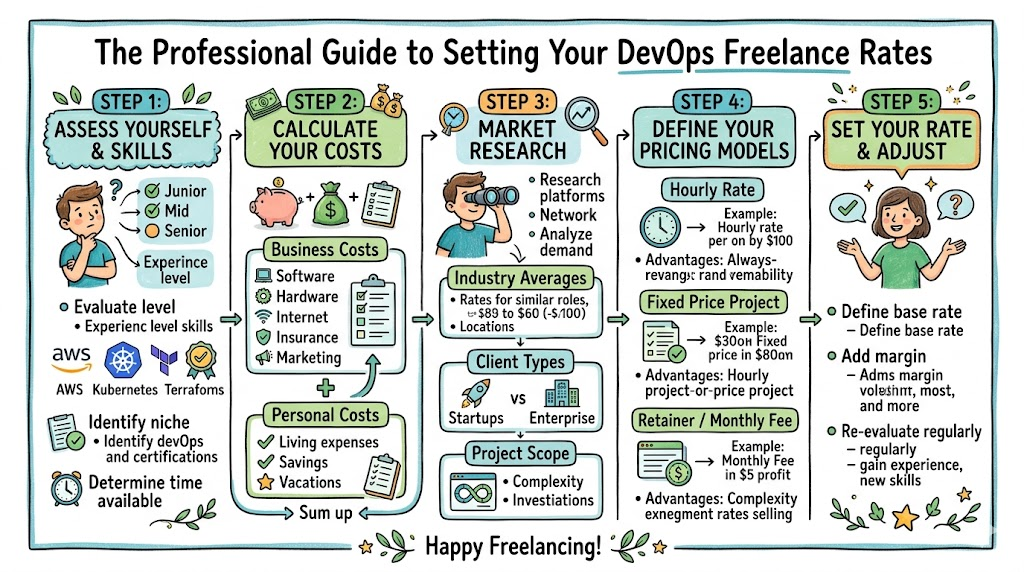
Different DevOps Freelance Pricing Models
Choosing the right pricing model depends on the type of engagement and your personal preference for cash flow consistency.
| Pricing Model | Best For |
| Hourly Pricing | Small, undefined tasks, troubleshooting, or ad-hoc support. |
| Project-Based Pricing | Clear, defined scopes with specific deliverables and deadlines. |
| Monthly Retainer | Long-term maintenance, ongoing support, and trusted partnerships. |
- Hourly Pricing: This is the most common starting point. It is easy to calculate and lowers the barrier for entry for clients. However, it penalizes efficiency. The faster you work, the less you make.
- Project-Based Pricing: This requires you to estimate the time and scope accurately. It is highly attractive to clients because it provides budget predictability. If you are efficient, you can actually increase your effective hourly rate.
- Monthly Retainer: The “Gold Standard” for freelancers. It provides steady income for you and a guaranteed resource for the client. It is best used after you have established trust.
Beginner-Friendly Pricing Strategy
If you are just starting, do not aim for the highest market rate immediately. Instead, use a phased approach.
- Start with “Market Entry” Pricing: Look at what similar freelancers charge on platforms and aim for the middle of that range. Do not be the cheapest, as this signals low quality.
- Focus on Quick Wins: Take on smaller, well-defined projects to build your portfolio and testimonials.
- Audit and Increase: Every three months, assess your demand. If you are consistently booked, it is time to raise your rates by 10-20% for new clients.
Real-World Example: Freelancer Charging Too Little
Consider “Alex,” a DevOps engineer who charged $20 per hour to set up CI/CD pipelines. Because his rate was so low, he attracted clients who did not value his time. They demanded constant changes, had disorganized requirements, and expected him to be available on weekends for “emergency” fixes that were actually poor planning. Alex ended up working 60 hours a week just to make ends meet, suffering from burnout and having no time to learn new technologies. The lesson here is that low pricing attracts high-maintenance, low-budget clients.
Real-World Example: Freelancer Pricing Strategically
Contrast Alex with “Sarah,” who started her freelancing journey by packaging her services. She offered a “CI/CD Pipeline Setup Package” for a fixed price of $1,500. She did not sell hours; she sold a completed, working system. Because she had a defined scope, the client knew exactly what they were getting. Sarah spent 10 hours on the project, meaning she earned $150 per hour. She spent the rest of her week networking and learning advanced Kubernetes skills, which allowed her to eventually command even higher project fees.
Common Pricing Mistakes Freelancers Make
Avoiding these pitfalls will save you months of frustration:
- Copying others blindly: Just because someone else charges a specific rate does not mean their business model fits yours.
- No scope definition: If you do not write down what is included in the project, you will experience “scope creep,” where the client keeps asking for “just one more thing” for free.
- Charging too low to “get the job”: This is a trap. You will eventually resent the work and the client.
- Ignoring the value: Stop thinking about the time it takes you to write a script and start thinking about the value of the automation you are creating.
- Failing to track time: Even if you do project-based work, track your time. It is the only way to know if your pricing strategy is actually profitable.
Best Practices for Increasing Your Rates Over Time
You are not locked into your starting rates forever. Use this checklist to scale your income:
- Collect Testimonials: Social proof is the most effective way to justify a price hike.
- Specialize: Generalists are a dime a dozen. Specialists in high-demand areas like FinOps, Security (DevSecOps), or specific Cloud Migrations command higher fees.
- Document ROI: Always ask clients for metrics. Did you save them money? Did you speed up deployments? Keep these numbers.
- Improve Communication: Being easy to work with is a competitive advantage. Respond quickly and keep clients updated.
- Upgrade Your Toolkit: Master new, cutting-edge tools that others are afraid to touch.
How DevOpsSchool Helps Freelancers Build Skills
At DevOpsSchool, we provide the practical, hands-on training that gives freelancers the confidence to charge premium rates. Freelancing requires more than just knowing how to run a command; it requires understanding the entire lifecycle of software delivery.
By engaging with our structured learning programs, you gain exposure to:
- Real-world CI/CD pipeline implementation.
- Deep-dive infrastructure as code practices.
- Cloud-native architecture patterns that are highly sought after in the market.
- Best practices for monitoring and observability.
Building your skill set through a reliable ecosystem ensures that when you step into a freelance role, you are not guessing—you are executing with the precision of a senior engineer.
Career Opportunities for DevOps Freelancers
The market is hungry for freelancers who can handle the modern tech stack. Common areas where freelancers are currently in high demand include:
- CI/CD Setup: Helping teams automate their software delivery process.
- Cloud Automation: Migrating legacy infrastructure to AWS, Azure, or GCP.
- Kubernetes Support: Managing clusters, troubleshooting nodes, and handling service meshes.
- Monitoring Setup: Implementing logging and alerting systems like Prometheus and Grafana.
- Infrastructure as Code (IaC): Writing Terraform or Ansible scripts to make environments reproducible.
To succeed here, focus on being a “T-shaped” professional—having a broad understanding of the full DevOps lifecycle and deep expertise in one or two specific areas.
Industries Hiring DevOps Freelancers
If you are looking for clients, these sectors are currently experiencing high demand for DevOps services:
- SaaS Platforms: Startups need to deploy features quickly and reliably.
- FinTech: High security and compliance needs make DevOps essential.
- Healthcare: Managing sensitive patient data requires robust cloud infrastructure.
- E-Commerce: Scalability during traffic spikes is a primary concern for these platforms.
- Enterprise IT: Traditional companies are undergoing digital transformation and often lack the internal expertise to execute it alone.
Future of DevOps Freelancing
The future of DevOps is shifting toward platform engineering and AI-assisted operations. Freelancers who can help companies build internal developer platforms—where developers can self-serve infrastructure without needing to wait for a ticket to be resolved—will be the most valuable assets in the market.
Additionally, as AI tools become more integrated into the dev cycle, the role of the DevOps engineer will evolve into a “Cloud Architect” role, focusing more on high-level strategy and security rather than simple configuration.
FAQs
- How do I set DevOps freelance rates if I have zero experience?Start by researching the entry-level hourly rates in your target market and set your price slightly below that to win your first few projects. Focus on acquiring testimonials rather than maximizing profit in the first three months.
- Should beginners charge hourly or per project?Beginners should usually start with hourly rates. It is much easier to manage scope when you are learning how long tasks actually take to complete.
- Can freshers freelance successfully?Yes, but you need to demonstrate that you can solve a specific problem. A portfolio of personal projects on GitHub can act as a substitute for professional work history.
- How do I avoid underpricing my services?Know your floor price—the minimum amount you need to earn to cover your expenses and time. Never go below this, regardless of the client’s budget.
- Does cloud expertise significantly increase rates?Absolutely. Specialists in AWS, Azure, or GCP are far more valuable than general IT support. The deeper your specific knowledge of a platform, the more you can charge.
- Should I offer discounts to get clients?Avoid permanent discounts. If you must offer a discount, frame it as a “startup discount” that is only valid for the first project, or offer to reduce the scope instead of the price.
- What if clients try to negotiate my rates down?Stand your ground politely. Explain the value you provide. If they cannot afford your rate, it is often a sign they will be difficult to work with.
- How do I safely raise my rates for existing clients?Give them notice. Explain that your demand has increased or that you are upgrading your service offerings. Most fair clients will understand, and if they don’t, it is time to move on.
- Do I need a formal contract for every job?Yes. Always have a contract that defines the scope, payment terms, and timelines. This protects you from disputes.
- Is it better to work for one long-term client or many small ones?Long-term clients provide stability, while many small ones provide variety and skill development. A hybrid approach is often best for a sustainable career.
- Does location affect my freelance rates?It can, but the internet has leveled the playing field. If you provide high-quality, professional, and reliable work, you can charge top-tier global rates regardless of your physical location.
- How often should I review my pricing?Review your pricing every 3 to 6 months. If you are fully booked, it is a clear signal that your rates are too low.
- What is a “Retainer” and how do I structure it?A retainer is a monthly fee for a set number of hours or for “peace of mind” availability. Structure it based on the average time you expect to spend on maintenance and emergencies.
- Do I need to disclose my rates upfront?It depends on your strategy. Posting a “starting at” rate on your profile can filter out clients who have no budget, while negotiating custom rates allows for more flexibility.
- What is the most important skill for a high-paid DevOps freelancer?Reliability and communication. Being a genius with Kubernetes matters little if you disappear for three days or cannot explain your work to stakeholders.
Final Thoughts
Pricing is not a static number—it is a reflection of your evolving value. As you gain more experience, collect more success stories, and master complex cloud ecosystems, your rates should naturally rise. Do not view pricing as a barrier to getting clients; view it as a filter that helps you find the right partners who respect your expertise.
Consistency is key. Whether you are charging hourly, per project, or on a retainer, ensure that your output remains high-quality. Clients will happily pay premium rates for a freelancer who solves problems reliably and allows them to sleep better at night. Remember, your career is a marathon. Start where you are, keep learning, and adjust your pricing as you grow into the consultant you are meant to be.
